
Source of truth
Offstage works best when each piece of information has one main home.
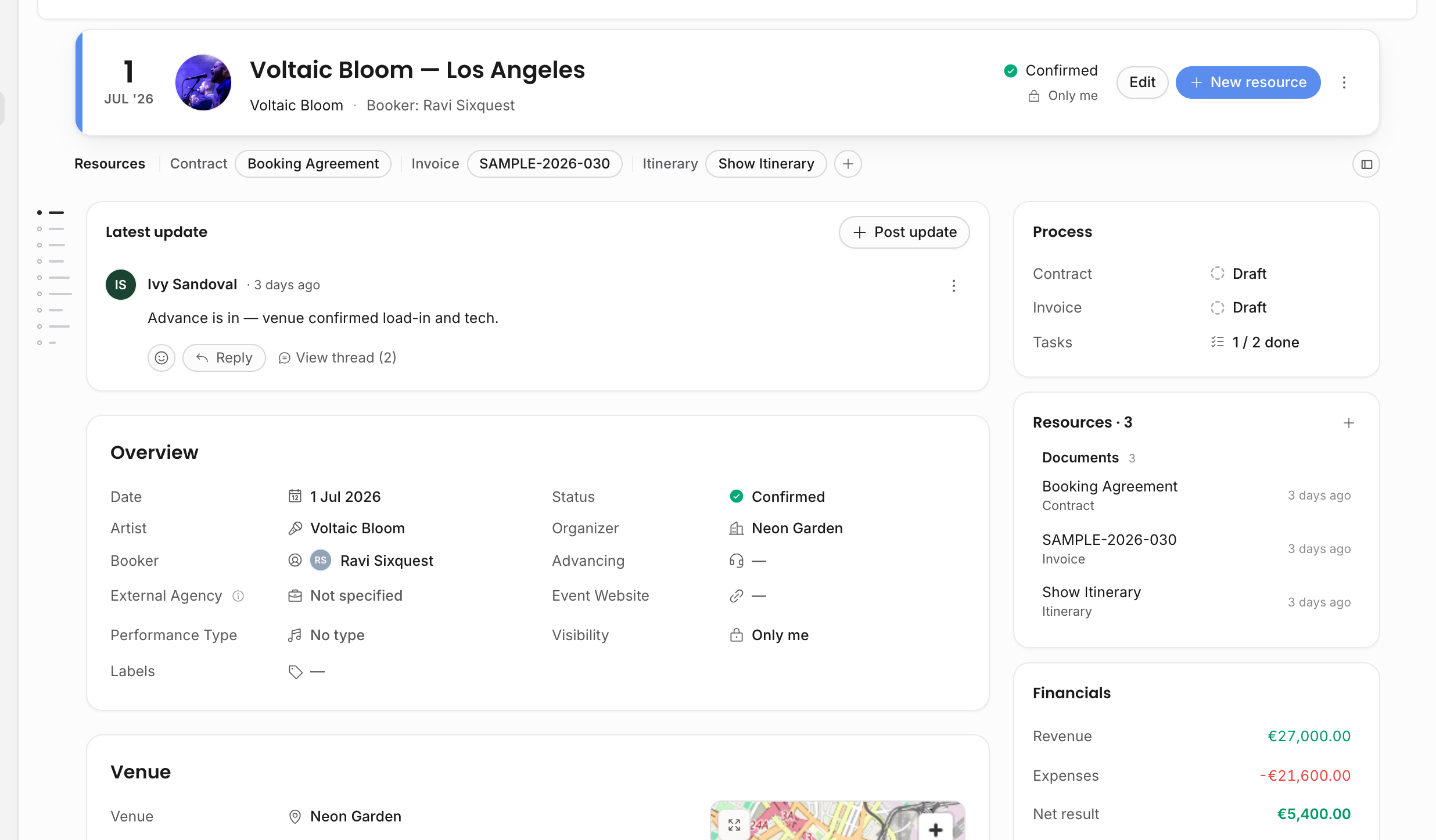
Main homes
| Information | Source of truth |
|---|---|
| Show date, venue, times, artist, booker, and status | Event detail page |
| Revenue and expense lines | Event financials |
| Contract wording | Contract document body and template |
| Invoice total, payment schedule, payments, credit notes | Invoice and credit note records |
| Artist legal, billing, banking, travel, and social data | Artist page |
| Venue, organizer, company, and person contact data | Address book |
| Team access | Roles, permissions, and artist scope settings |
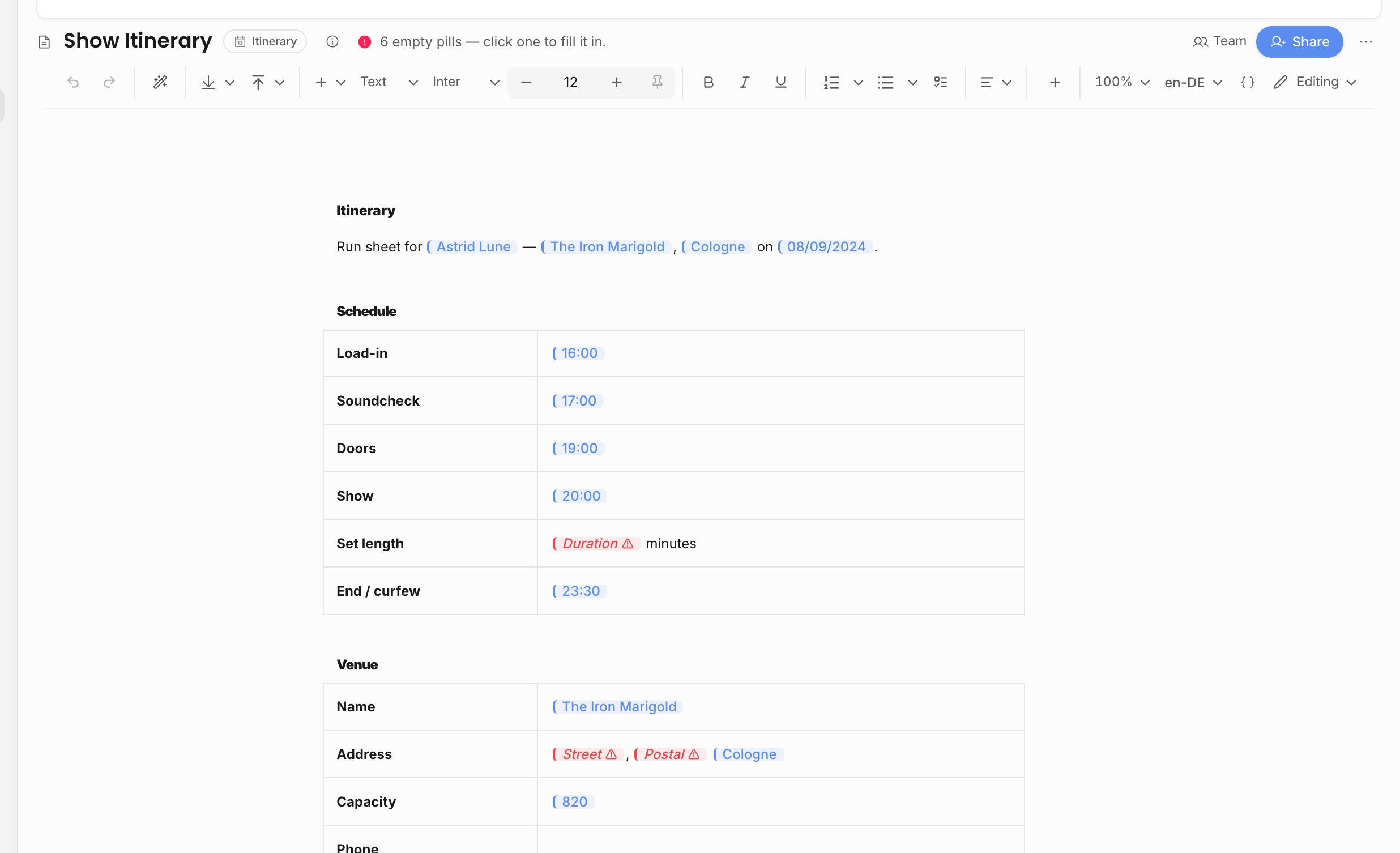
Documents can render data from those sources through live pills. Analytics reads from the underlying records and respects permissions.
Why this matters
Source of truth prevents the team from maintaining the same fact in several places. If the venue address changes, update the event or address book record that owns it. If a fee changes, update the event financial line or the contract/invoice line that owns the commercial state. If a bank detail changes, update the artist or organization record that owns the payment data.
Typed document text is useful for narrative clauses and one-off wording, but it is a weak place to store operational facts. A document can become outdated if it contains static copies of dates, addresses, line items, tax details, or payment instructions that are also stored elsewhere.
Documents read from source records
Live pills let a document pull values from the event, artist, organization, counterparty, line items, payment schedule, or custom fields. Use them when the document should reflect workspace data. Use typed text when the value is intentionally unique to that document and should not update from a record.
Loop tables and structured blocks follow the same rule. A contract or invoice table should be built from the line items it is meant to represent, not from manually typed rows that drift from the show.
Money has its own lifecycle
Event financials, contract deal lines, invoice billed lines, payments, and credit notes are connected but not identical. A show can have revenue and expense lines before a contract is sent. A contract can represent selected deal lines. An invoice can bill selected lines or a payment schedule. A credit note can correct, cancel, apply, or refund invoice value.
Do not flatten those states into one number. Use the right record for the question:
- event financials for booked value and operating margin;
- contracts for agreement value and signed state;
- invoices for billed value, due dates, sent state, and payments;
- credit notes for corrections and refunds;
- analytics for reporting across the underlying records.
Analytics is downstream
Analytics should not be edited directly. It reads from shows, artists, venues, organizers, bookers, line items, contracts, invoices, payments, and credit notes. If an analytics number looks wrong, fix the source record first, then check filters, permissions, scopes, and date ranges.
Related: Work a show, Live pills, Analytics access and scopes.