
Templates, pills, and copies
Templates, live pills, and document copies solve different problems.
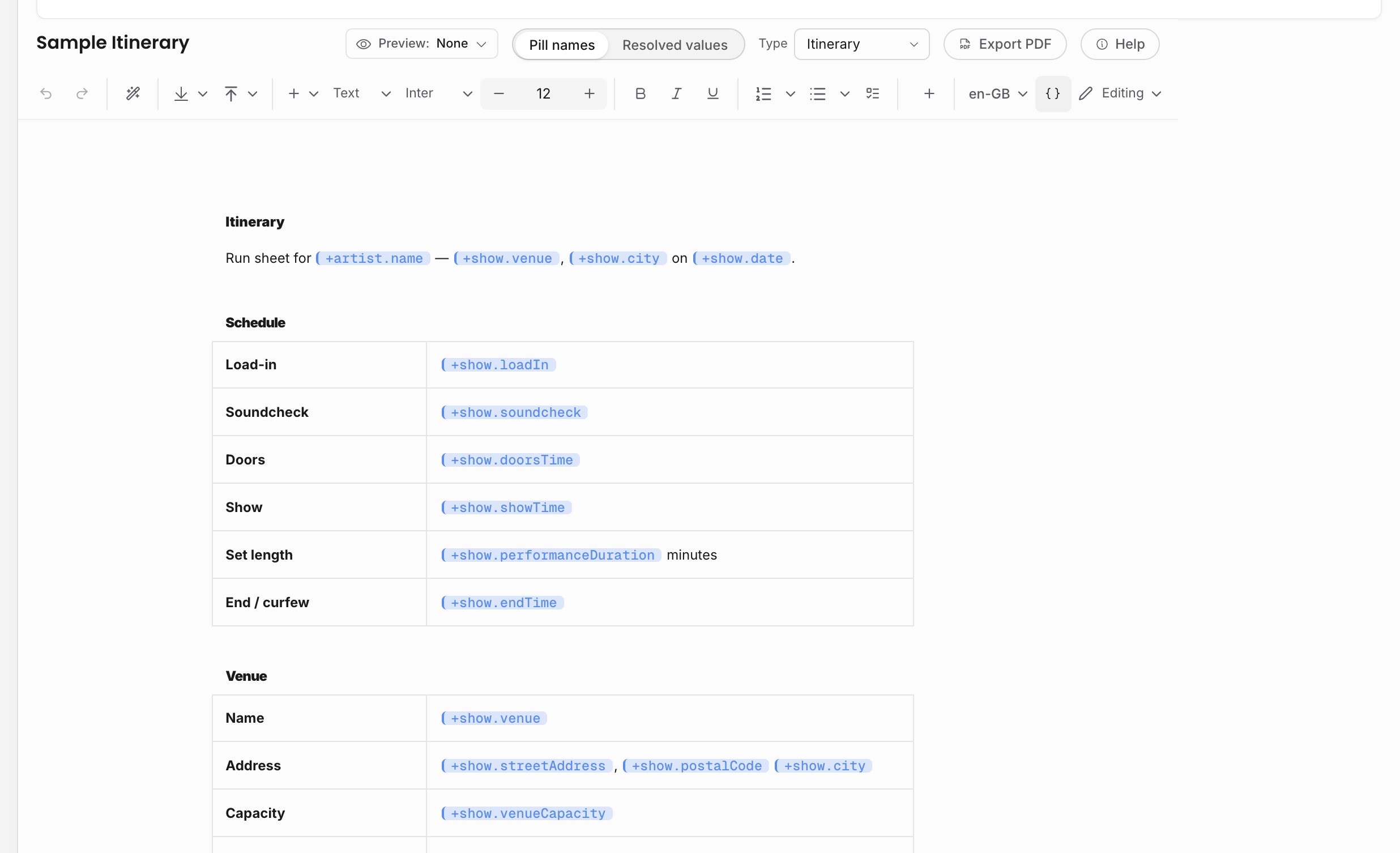
Templates
Use templates for repeatable structure: standard legal wording, invoice layout, itinerary sections, table structure, and default variables.
Templates are best when the agency wants a consistent starting point. A contract template can hold agreement structure and standard clauses. An invoice template can hold billing layout and payment wording. An itinerary template can hold repeated sections for routing, travel, hotel, and day-of details.
Do not use a template to freeze facts that should come from the workspace. If a date, venue, artist legal name, deal line, invoice total, or payment schedule should stay connected to the record, use a live pill or loop instead.
Live pills
Use live pills for values that should come from workspace data, such as event dates, venue addresses, artist billing details, line items, payment schedules, or custom fields.
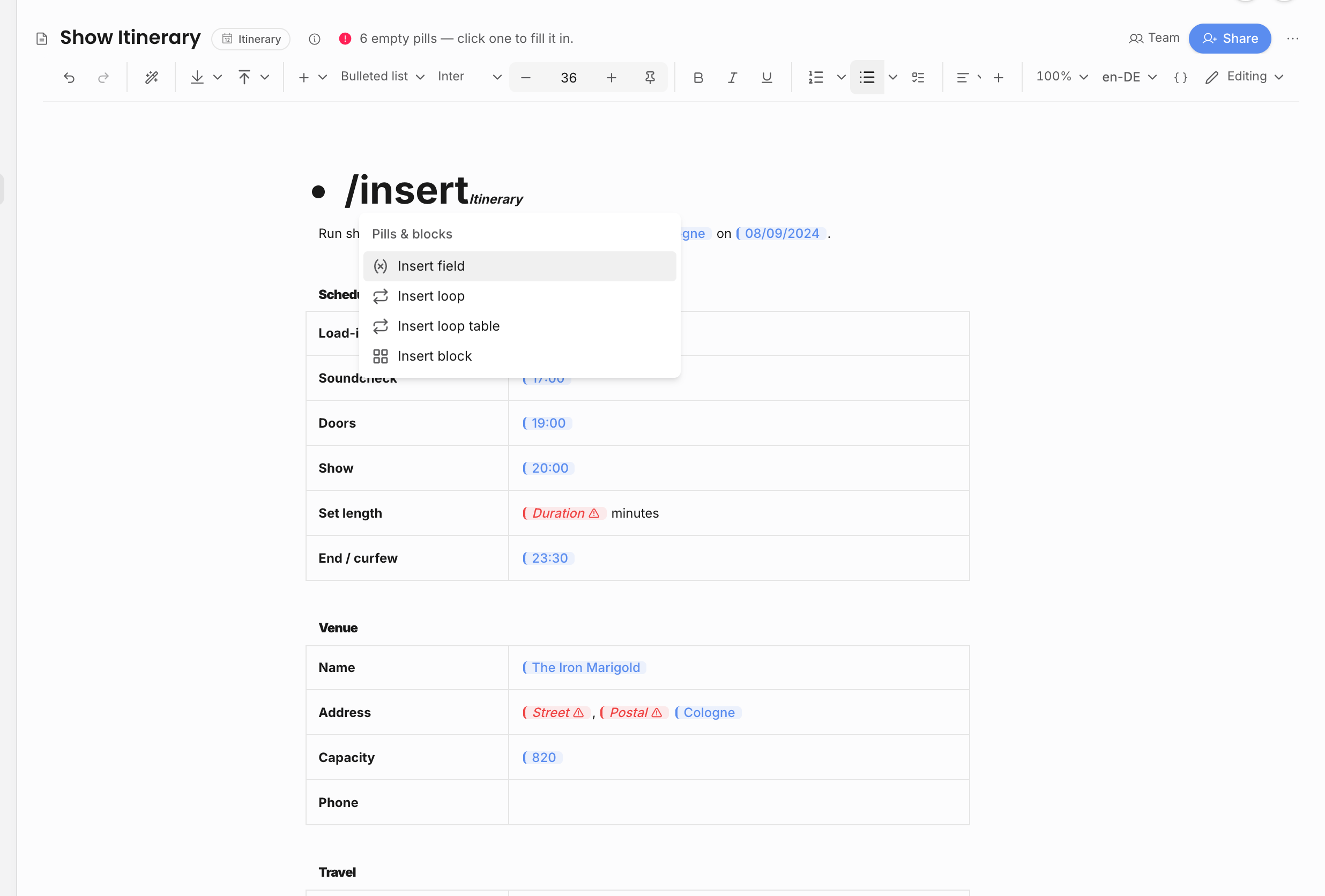
Live pills are the safest way to keep documents aligned with the source record. When the event, artist, organization, counterparty, invoice, contract, or custom field owns the value, the document should usually display that value through a pill.
Pills are especially useful for:
- show dates, cities, venues, addresses, and times;
- artist legal, billing, banking, and tax details;
- organization sender details and branding-adjacent data;
- contract deal values and selected revenue lines;
- invoice totals, due dates, payment schedule rows, and credit-note values;
- custom event fields that the agency wants to reuse in documents.
If a pill is blank, check the source record. A missing venue address should be fixed on the event or contact record, not typed into one contract. If a user cannot insert or resolve a pill, check permissions for the underlying data.
Copies
Copy an existing document when a prior document is the closest starting point. After copying, check every live pill, counterparty, financial line, and static clause that could differ from the original.
Copying is useful for one-off documents that are similar to a previous version but not standard enough to become a template. It is risky when the old document contains static text that looks like live data. After copying, review:
- the parent event or artist;
- the counterparty;
- selected deal or invoice lines;
- dates, venues, addresses, and payment terms;
- static clauses that mention a person, city, amount, or deadline;
- copied comments or suggestions if the workflow includes review.
Choosing the right starting point
| Need | Use |
|---|---|
| Same structure for many future documents | Template |
| Current workspace data inside the document | Live pills or loop blocks |
| Rows for selected line items, contacts, or schedules | Loop table or structured block |
| A one-off variation of an older document | Copy |
| A sentence that should never change automatically | Typed text |
When in doubt, prefer source data plus pills for operational facts, and typed text for human-authored wording.
Related: Document templates and branding, Live pills, Create and edit documents.